← Back to alternatives

Cap vs Tella: Storage Flexibility vs. Tutorial Editing

Cap and Tella take different approaches to screen recording — one is open source with the most flexible storage of any tool in this category, the other is built specifically for polished tutorial and course content.

CapabilityCapTella
Open sourceYesNo
Self-hosted storage optionYesNo
Records locally by defaultYesNo
Teleprompter & tutorial editing toolsNoYes
AI summariesPartialNo

Cap is an open-source screen recorder: Studio mode records locally, and you can store recordings in Cap Cloud, your own S3 bucket, or a fully self-hosted server — the most flexible storage model of any tool covered here. Tella is closed-source and purpose-built for creators, with transcript-based editing, a teleprompter, automatic zoom, and filler-word removal, streaming the recording to the cloud live as you record.

Cap's AI suite — transcripts, titles, summaries, chapters — is a cloud-processed feature gated behind its Pro tier; on the free tier, recording is local but AI processing isn't. Tella doesn't document AI summarization at all, though its editing tools (teleprompter, filler-word removal) serve a similar "polish before you share" goal from a different angle.

If storage sovereignty matters most — self-hosting, your own bucket — Cap's flexibility is unmatched here. If the job is producing tutorial or course content fast, with editing tools built for that specific format, Tella's toolset is more purpose-built.
The 3rd option

Or get on-device AI without choosing a storage model first

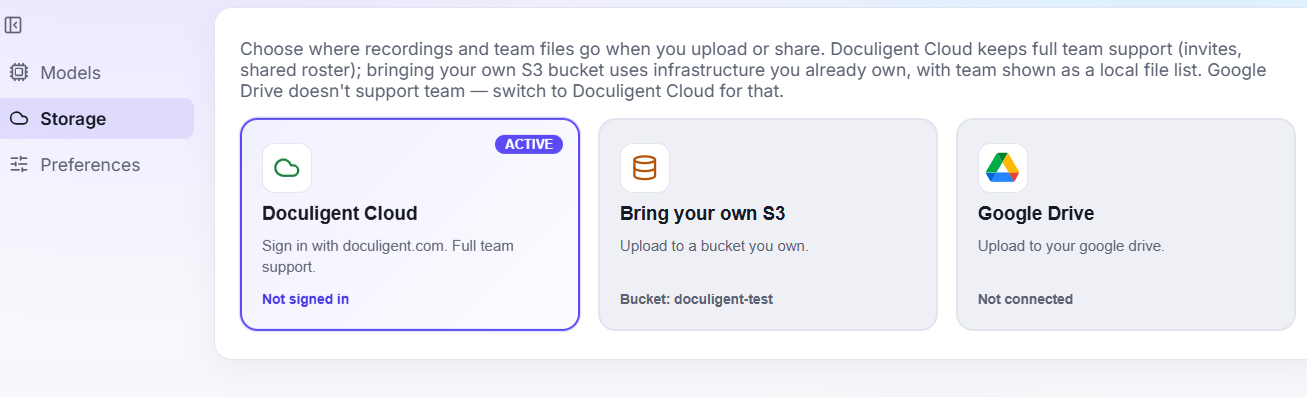
Doculigent's local-first behavior is the default, not a setup step: recording, on-device transcription, and AI summaries all happen locally with no server to configure. You still get to choose where a recording ends up if you share it — Doculigent Cloud, your own S3-compatible bucket, or Google Drive.

Unlike Cap, that AI layer runs on-device rather than behind a Pro-tier cloud feature. And like Cap, Doculigent is open source, so you can verify what it does rather than taking a vendor's word for it.

Frequently asked questions

What are Tella alternatives?
Alternatives to Tella include Cap (open source, flexible self-hosted storage), Loom (fast async sharing), and Doculigent, which keeps recording and AI processing local by default — see how Doculigent compares to Tella.
What are Cap alternatives?
Alternatives to Cap include Tella (tutorial-focused editing) and Doculigent, an open-source recorder whose on-device AI isn't gated behind a paid cloud tier — see how Doculigent compares to Cap.
Is Cap really open source?
Yes — Cap's codebase is public under AGPLv3, with MIT-licensed capture components. Doculigent is open source too, with its code public on GitHub.